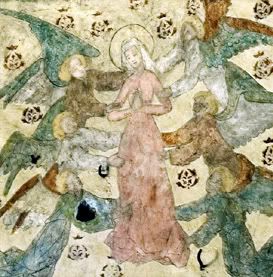
Showing posts with label saints and feastdays. Show all posts


A Shabbas Table: "The Floating Monastory"

(Top image is of St Catherine holding the Church-as-a-ship, next one of the Church-ship as a healing light/lamp...which will make more sense later)

A couple posts ago, shared a qoute about trusting God "even for the weather". And also how it was the gift of rain that helped calm something when was at a stress highpoint this week. Well, the stress is still going on honestly...between all these doctors visits, and being dizzy all the time and barely able to swallow, and not being able to rest or feel "at home" becuase of all the noise here (at night too), not to mention the chemical sensitivity going through the roof more and more from all the fumes, and the exhausting dance of having to open and close the windows all day long...well i've been seriously about to lose it. But the experience Wednesday with the rain has really stayed with me as a comfort, a rope to hold in a sense. Keep remembering how something about the rain "softened the edges" of things somehow. And how i'd heared so strongly "notice this" (notice how the rain had made such a difference). It had made me think then of the "not a desert but an ocean" image that keeps coming up a lot. And i've found myself going back to it again and again through the stress of late, something keeps beckoning.

One image thats really stood out lately is what is called the "floating monastory". This is an ancient Celtic custom that i'd recently read about when was exploring St Brenden before. To set the scene before going into it, in the early days of Christianity there was a growing tradition of the "desert" monastics... which began in the Middle East and made its way over into Europe. Its what has still influenced monastic life greatly today. But it was not the only path there, i am just more and more convinced of that. I look back to Biblical times and see plently of desert images... Christ in the Desert, God in the Burning Bush, Elijah in his desert cave. But there are also plently of very deep water images. Baptism itself, Christ calming the waters, Noah's ark, Jonah and the whale, Rebekka at the well, and so many more i'm sure. More and more i am convinced that the desert is not the only path/image for living a life more "set apart" life....there is also the ocean.

The thing is, the desert is a traditional place for soldier training and the early desert monastics saw their going apart as a sort of spiritual warfare. Warfare and battling is really bound in with the archetype of the desert it seems...the desert even battles with our own bodies, making us become more rigorous just to survive in it. Such perfect training for a soldier or a hero really, for toughening up for battle (physically or spiritually). And it sure was fitting for our most ultimate Hero (Hero to say the least), Our Lord, who frequently went to the desert of fast and pray. But.... what about Mary? She too had a sacred role to play and the desert was not her training ground for it.

And so ....what about her daughters? Men and women are not just "the same" after all, a woman is not typically designed to be hero or soldier but rather a nurturer and "keeper". And so while the desert is the perfect place for preparing the courage and rigor and toughening up one needs as a soldier... i feel it makes less sense for helping create the softness and openess and such needed so badly for a nurturer. What feels to provide that more strongly isnt the desert but the ocean as the image. Well, this has been explored a bit before...

But this new image that came acrosss recently was this Celtic idea of the "floating monastory". While those in the Middle East tended to off into the desert when there was the need for a spiritual pilgrimage or an especially prayerful and set apart life, those in the Celtic world tended towards the sea (such as St Brendon's sea voyage, of course, but also many others). The boat then became the monastery, the ocean in the place of the desert. And i dont know too much about these "floating monasteries" yet (couldnt find much) but the image itself really feels to really hold something. Becuase the Church herself has been traditionally seen as a ship....and a ship needs the ocean, not the desert. So this feels to be a very powerful image.

About the Church as ship, from here:

As those outside of Noah's Ark were destroyed, the ship became a perfect early symbol of the Church. In the same vein, the main part of a church's interior, the place where the people worship, is called a "nave," from the Latin "navis" -- ship.

and here:

The image of the Church as a boat in which the faithful find refuge from the sea of the world is extremely commonplace in medieval iconography. The architecture of the church building itself is meant to recall an image of a boat; the "nave" (from the Latin "navis" meaning "ship") is often constructed so that the roof resembles an upside-down ship's keel.

And there were some further thoughts in this vein back here.

Anyway, ive just been very drawn to this image of the floating monastery lately. The ship rather than the traditional "cell". Perhaps becuase my life seems to reflect the former more it seems, so far anyaway, so maybe i should just accept it. My little ship here (this little vintage trailer) will be moving yet again now. I knew when i moved here it was temporary and all that, knew the highway's fumes couldnt be lived by for long with the chemical sensitivity and all. But i did so enjoy the wilderness part of being here (how ironic, living on such a noisy-fume-y highway yet still being able to walk up the hill to such deep wilderness that was so dear). I had no idea though just how quickly that move would need to happen until all the new noise happened, along with the continuing impact of the fumes of course. But really, i'd have had to move eventually becuase of the fumes anyway, all this did was speed it up, so i shouldnt be complaining.

Have found someplace to move to, but its more in the city, which i was really trying to avoid. But i'm trying to trust its been found for a reason...and i'm gratfeul for it. Its offroad from the main street so there wont as much traffic fumes as here, and the neighbors (as far as i know anyway) seem quieter at least... so i'll be moving next week or so, and we'll see. This wont be where i "land" though, i can see that already, becuase its too close to neighbors. When someone has chemical sensitivity they need to be far from neighbors (unless those neighbors share or respect your sensitivity, which is rare)...becuase if not then eventually there's usually conflict due to their fumes making you ill. I know that now, though it took me awhile to admit it....its simply the reality. So i either need to somehow have a miracle happen of having land away from city and neighbor fumes to finally ground and be at home (blissful sigh, smile)....or i need to truly embrace this image of my home-cloister here as a ship, simply being led by Him even if not grounded in the traditional way. Or maybe both, that would be heaven. Will have to see what unfolds.

At any rate, the ship image has been such a healing one lately. Its grounding comes not from an owned and claimed spot of earth, but rather from a sacred life in itself, from here:

A way of life - a floating monastery:

The journey was guided and shaped by the rules, not of navigation alone, but of the monastery from which Brendan started out - feasts, festivals, fasts and psalms.

When he left his original more traditional monastory walls, he built them on the ship really.... through "feasts, festival, fasts and psalms". Such food for thought.

And the ship image goes further too , from here:

The ship (bark or barque, barchetta) was an ancient Christian symbol. Its is the Church tossed on the sea of disbelief, worldliness, and persecution but finally reaching safe harbor with its cargo of human souls. Part of the imagery comes from the ark saving Noah's family during the Flood (1 Peter 3:20-21). Jesus protecting the Peter's boat and the apostles on the stormy Sea of Galilee (Mark 4:35-41) (is another.... And it is also symolic of) a means of conveyance between this world and the next. In Christian tradition, in which earthly life was seen as a pilgrimage, the ship of the church transports the faithful through the seas of the world to the heavenly home.

Through ths ship image, home really becomes simply...God. He is leading ones little ship. I am just finding more and more healing in this image.

Well, prayers for all that is happening would be so cherished if anyone is willing....for physical healing, for peace and quiet, for a calm and successful move, but most of all for a deepening trust.

A Very Blessed Shabbat all, and a wonderfully healing Sabbath : )

(Images from here and here)

A Sacred Table: Feastday of the Queenship of Mary

Blessed Feastday : )

The importance of feastdays has really been sinking in more and more. Things have been very trying lately to be sure....and feastdays really do help put things more in perspective, the deeper picture...the deeper life. The devotion of Medieval life in particular really revolved around sacred feastdays... and i so long for this.

But its more. Its the history of them, including the modern ones. When it comes to many of them their origins are ancient and Biblical, and yet they are instated later.... at the time in history when they are truly needed most. Talk about wisdom and healing! About today's feastday, from here:

In 1942, Pope Pius XII proclaimed this day (August 22) in honor of the Immaculate Heart of Mary and in 1945 he established this holiday of devotion to Mary in her compassionate aspect. Both were acts of spiritual warfare, designed to pose Mary and Catholicism as supreme weapons in the battle against godless Communism.

Then their is the "mirroring" aspect of feastdays, how they deepen the connection between heaven and earth, let us feel heaven a little closer. Yet is also goes the other way around too, from here:

The gospel reading for the Queenship of Mary is the story of the Annunciation, and what struck me at Mass today was the fact that the royal status of Mary was established on earth historically before it was established in heaven. First of all it was established because Mary was the wife of Joseph, who, Matthew's geneology tells us was descended from King David. Secondly it was established through the message of the angel. Mary's son will receive the throne of his Father David, and he will rule of Israel (Lk.2:32,33) This fact makes Mary the Queen Mother of Jesus the Lord, the King of Israel.

Her crowning in heaven is simply the ultimate fulfillment of her role on earth. When we see her in the Book of Revelation crowned with twelve stars (Rev.12:2) the symbolism and her function are complete. The twelve stars represent the twelve tribes of Israel and the twelve apostles--symbolic of her son's rule as the King of Israel and the everlasting Ruler of the Apostolic Church. Her role as Queen of Heaven is therefore the completion of her role as the hidden Queen Mother of the King of Israel here on earth.

What I find intriguing about this is the idea that an event in heaven parallels a reality on earth. If this is the case with Our Lady, then perhaps it is also the case with all of the redeemed. Mary's Queenship on earth was always humble and lowly and full of suffering-- for a sword pierced her own heart also. However, this lowly and humble Queenship on earth was magnified and brought to its full reality and full glory as she was assumed into heaven and crowned as the Queen Mother of her Son.

Is it the same with us? I think so. Certainly our participation in the sacraments is a time when our actions on earth are mirrored in heaven. When we repent the angels rejoice. When we participate in the Eucharist we share in the wedding feast of the Lamb in heaven. When we are baptized, confirmed or ordained we are given a new and everlasting character.

Furthermore, perhaps all our earthly sorrows, trials and tribulations have a parallel version in the cosmos--a sort of mirror version which is far more glorious than we can ever imagine. Are our lives hidden? Do we struggle day after day to realize the glorious royal potential to which we are called? I believe on the other side it will all be transformed. Here we see through a glass darkly. Then we shall see things as they really are. Then we will be blinded by the awesome beauty of reality, for we shall see Him as he is who is Reality itself. Then every last detail of our lives will be redeemed and transformed into an intricate and eternal plan of glory that is far more beautiful and profound than we can now comprehend. (bolding my own).

This just really moved something, reading this. Especially that part about things being transformed. It so much reminded me of that dream from last Candlemas, when there was a beach stick on the mantle and in the dream i woke up there to find it suddenly beautifully embellished....with the realization that perhaps that is what happens in heaven. That that is why we so need to be simple and mindful and devoted and carefully pay attention to details.... rather than rush rush rush and gather gather gather gather. Why we need to not be cluttered or scattered, inside or out....becuase it will all get em-bell-ished in the end. And depending on how we have lived, that em-bell-ish-ment can then bring rich and peaceful beauty or it can bring overwhelm and chaos. Well, those were the feelings of the dream anyway, for what they are worth. I just find myself thinking back to it today.

This truly is a beautiful feastday today. And we need this reminder today more than ever it seems. This wonderful reminder that our own dear Blessed Mother is indeed Queen of Heaven, and the most loving Queen or Mother we could ever dream of....
For human life is short, but Mary reigns above, a Queen forever--Cardinal Newman

A Very Blessed Feastday Everyone : )

(Image from Standing on My Head)


A Shabbas and Feastday Table: "Assuming" Joy

Today is the feastday of the Assumption of the Blessed Mother...though in my head i kept misakenly thinking today was St Helena's feastdayfor some reason, go figure.

But it really is a beautiful feastday today! Such a deep one. Tea at Trianon had this wonderful reflection:

On November 1, 1950, Pope Pius XII in the bull Munificentissimus Deus defined the dogma of the Assumption of the Blessed Virgin Mary. The teaching that the Immaculate Mother of God was taken body and soul into heaven at the close of her earthly existence has been the constant belief of the universal Church, as ancient liturgical manuscripts bear witness. "Everything tends to indicate that the privilege of the Assumption was explicitly revealed to the Apostles...and that it was transmitted subsequently by the oral tradition of the Liturgy," wrote Fr. Reginald Garrigou-Lagrange in The Mother of the Saviour and Interior Life.

It was not until the middle of the twentieth century, a century so traumatized by genocide, mass murders, world wars, the breakdown of modesty, morality, and family life; the spread of false ideologies such as communism, socialism, and feminism, which promise to liberate but in reality only enslave and destroy, that the pope was moved to declare the dogma. "The political, social, and religious atmosphere in the middle of the twentieth century influenced greatly the decision of the Pope" so that "mindful of the human misery caused by war, of the ever present threat of materialism and the decline of moral life, and of the internal problems that disturbed the Church, [he] turned to Mary, confident of her intercession." Pope Pius XII "believed...that calling attention to the bodily Assumption of Mary would remind all men and women that the human body is sacred, that the whole person is holy and destined to live forever." (Fr. Kilian Healy, O.Carm. The Assumption of Mary)

For those who struggle to offer to God hearts free from all stain of actual sin, who strive to experience even in this life the joys of union with God through contemplation, the mystery of the Assumption is one which characterizes a way of life.


I really love that...the mystery of the Assumption is one which characterizes a way of life. Talk about "not a desert but an ocean" : )

I was thinking on this passage as i was doing the dishes earlier. Its been a challenging day here, really really hot and expected to be heavy and wind-less tonight and mega hot again tomarrow. Coupled with financial issues and health issues that are really up right now, ive been pretty stressed. But as i was standing there doing the dishes, it was weird, but i "caught" myself being happy. Hard to describe. It was like i was watching my own heart and thinking, "hey, i shouldnt be happy", like i had caught myself doing something wrong. It only lasted a second. But i saw just how insane that was.... happiness bubbles up...and i squish it, like its some sort of sacriledge to be happy when stressful things are happening.

And it got me thinking about this "assumption as a way of life" idea. Maybe choosing joy is how we can turn there really, "looking up" in the deepest sense. It seems like such an act of rebellion and defiance almost, allowing joy when there is so much stress, and so much evil, around us. But maybe thats the whole point....this not losing hope. Mary never lost hope, and she had every reason to when her Son was crucified. Really, she had every reason to even as a young girl just seeing the horrific state of the world around her. But she truly truly hoped. And just look what happened.

Hope doesnt mean you ignore problems...when one is hopeful one hopes for solutions, or reaches out in their own way. Hope is trust after all, and trust opens the heart. But even admitting problems are there and longing for their healing, this longing can still be lived with joy. Joy that comes from hope and trust....or rather faith hope and trust as Peter Pan would say, smile. That story actually really comes to mind....it wasnt until they had that "faith hope and trust" that they could fly. Maybe a hopeful joy really is behind assumption as a way of life. I don't know, something about that just won't let go today. Really, don't even the images of Our Blessed Mother below (will be inserted later, blogger wont let me now) look an awful lot like the ultimate in "faith hope and trust"? To say the least : )

I know we can never be Mary, or hope for her Sacred Assumption of course....but we can still long to be like her, like a daughter longs to be like her Mother : ) An "assumption way of life" just sounds so amazing.

Well, Blessed Feastday Everyone...and a Blessed Shabbat and Sabbath too : )

(Images from here, here and here)

A Sacred Table: Blessed Feastday of St Helena

(Prenote added later: Whoops, this was early, her feastday is actually the 18th, i just had the 15th in my head for some reason....so happy feastday early lol)

Today is the feastday of St Helena, the woman who, trusting a dream she had been given, sought out and actually found the One True Cross. The ultimate pilgrim she was, to say the least : )

Have posted on St Helena before as she is a dear and favorite saint... so rather than repost just thought i'd share past links (here, here, here)

A Very Blessed Feastday All : )

(Sculpture by Lynn Kircher and clipart from here)

A Pilgrim's Table: Hope as Anchor

Anyone see the meteor shower tonight? Sooooo beautiful. And looking up like that, it makes me feel so small again...lovingly guided, cared for...hopeful.

Hope, it truly is an anchor i think, a precious one. Came across a prayer in this vein that just cant help but share here. Its by Saint Claude de la Columbiere, and is based on Psalm 4. The prayer has been called "Act of Hope", and some excerpts (taken from here and here) are combined below:

"In peace I will sleep and I will rest for Thou hast wonderfully established me in hope.”

My God, I’m so persuaded that You watch over all who hope in You and nothing can be lacking to those who await from You all things, that I have determined to live from now on without any concern, letting go and giving You all of my anxieties. I will sleep and rest in peace because You, O Lord, and only You, have secured my hope.

Men can deprive me of possessions and reputation; illnesses can take away my strength and means to serve You; I myself can lose Your grace because of sin; but I will not lose my hope; I will conserve it until the last instant of my life and all the efforts from demons trying to take it away from me will be useless. I will sleep and rest in peace.

Others may look for happiness from their riches or their talents; they may rely upon the innocence of their lives, the rigour of their penance, the number of their good works, or the fervour of their prayers; but for me, O Lord, my confidence shall be my confidence itself. For Thou hast wonderfully established me in hope.

And boy does he go to the heart of simplicity too, through this Sacred Heart devotion:

It is a great illusion to want all you hear about and all you see in books, as well as to burden yourself with so many devotional practices. Read very few books and make a great study of Jesus Christ crucified.


And sure can't skip this qoute of his on silence:

During His Passion, Jesus found Himself in every circumstance in which it is most difficult to remain silent . . . He had every reason in the world to speak: He had His Father's glory to win, His doctrine to uphold, scandal to be avoided; He was going to lose all the fruit of His labors. The priests commanded Him, Pilate questioned Him: Jesus remained silent. He would not have sinned, He would have given very edifying replies, but His silence is worth a thousand times more .

Silence. Simplicity. Sacred Hearts. Hope. They just feel so deeply connected somehow....

(Image from Kay of He Gently Calls Us)

A Feastday Table: Candle in the Darkness

Today is the feastday of the Transfiguration. Blessed Feastday : )

From here:

A foretaste of the Kingdom: the Transfiguration

From the day Peter confessed that Jesus is the Christ, the Son of the living God, the Master "began to show his disciples that he must go to Jerusalem and suffer many things. . . and be killed, and on the third day be raised." Peter scorns this prediction, nor do the others understand it any better than he. In this context the mysterious episode of Jesus' Transfiguration takes place on a high mountain, before three witnesses chosen by himself: Peter, James and John. Jesus' face and clothes become dazzling with light, and Moses and Elijah appear, speaking "of his departure, which he was to accomplish at Jerusalem". A cloud covers him and a voice from heaven says: "This is my Son, my Chosen; listen to him!"

For a moment Jesus discloses his divine glory, confirming Peter's confession. He also reveals that he will have to go by the way of the cross at Jerusalem in order to "enter into his glory". Moses and Elijah had seen God's glory on the Mountain; the Law and the Prophets had announced the Messiah's sufferings. Christ's Passion is the will of the Father: the Son acts as God's servant; the cloud indicates the presence of the Holy Spirit. "The whole Trinity appeared: the Father in the voice; the Son in the man; the Spirit in the shining cloud."

You were transfigured on the mountain, and your disciples, as much as they were capable of it, beheld your glory, O Christ our God, so that when they should see you crucified they would understand that your Passion was voluntary, and proclaim to the world that you truly are the splendor of the Father.

On the threshold of the public life: the baptism; on the threshold of the Passover: the Transfiguration. Jesus' baptism proclaimed "the mystery of the first regeneration", namely, our Baptism; the Transfiguration "is the sacrament of the second regeneration": our own Resurrection. From now on we share in the Lord's Resurrection through the Spirit who acts in the sacraments of the Body of Christ. The Transfiguration gives us a foretaste of Christ's glorious coming, when he "will change our lowly body to be like his glorious body." But it also recalls that "it is through many persecutions that we must enter the kingdom of God"


Elena of Tea at Trianon shared this lovely qoute today:

Let us run with confidence and joy to enter into the cloud like Moses and Elijah, or like James and John. Let us be caught up like Peter to behold the divine vision and to be transfigured by that glorious transfiguration. Let us retire from the world, stand aloof from the earth, rise above the body, detach ourselves from creatures and turn to the Creator, to whom Peter in ecstasy exclaimed: Lord, it is good for us to be here.--Anastasius of Sinai, from The Liturgy of the Hours according to The Roman Rite, 1975

And what jumped out so much personally today was how the Transfiguration is talked about in 2 Peter 1, with this conclusion:

.......attend, as to a light that shineth in a dark place, until the day dawn, and the day star arise in your hearts

Wow. A foretaste of heaven. Attending....

Reminds me too of this traditional Jewish qoute from the Talmud:

Three things give insight into the (pleasures of the) world to come: Shabbat, the sun, and bodily functions. --Talmud, Shabbat 10b

Well all three of those things meet in that proverbial flickering flame. In fact this was part of today's Mass:

Your lightnings enlightened the whole world---from the introit of the day's Mass, Ps. 76. 19

To me this is the core stuff really, this simply attending to His light. At-tending. Tending. Like keeping the flame, like keeping the home. It's keeping, at-tending. Advent-al Living.

And just love this qoute shared by Kay of He Gently Calls Us today, whose beautiful image is above as well:

All the darkness in the world cannot extinguish the light of a single candle.---Saint Francis of Assisi

WOW.

A Very Blessed Feastday Everyone : )

(Image from Kay of He Gently Calls Us)

A Sabbath Table: Feastdays of St Peter and Lammas

Though sadly ignored the past fourtysome years, today is the day of St Peter in chains, as well as Lammas. Its when we celebrate that St Peter was so often freed from his chains by God in the literal sense (not to mention the spiritual sense), and also when the grain harvest is traditionally celebrated and given thanks for. Both such fine traditons, and so deeply connected. We give thanks for our providence and for our protection.

One neat tradition here is something called a "need-fire". On Lammas (as well as in times of deep need) traditionally a special fire was lit. All other flame fires within a certain radius had ro be put out first, as well as, in more modern times, the electricity had to be shut off in a certain radius as well...in other words, no fire. Then when the need-fire was lit in this space of quiet and longing, it was considered deeply healing. The occult view would be this was "spellwork", which is nonsense. The true magic here i believe can be explained for example by a simple children's tale, a favorite of mine. Its a traditional Russian tale called "No Room" (Rose Dobbs has a nice retelling) , and i happened to come across it on a blog today of all days. From Lentils and Rice:

"I read a story once, a children's book, but I can't remember the name, about a man not happy with his life. His family was too noisy, the house was too small. He asked a wise man what to do, and the wise man told him to bring the dog and cat into the house, the next day he told him to bring another animal into the house. Each day, the man would go back, tell the wise man it wasn't working, and the wise man would tell him to bring something else into his house: the cow, the donkey, the chickens, the pigs, the in-laws, and so on. Soon, his house was full of chaos, noise, and mess, and was even more crowded than before.

The man went back one last time, and pleaded with the wise man for a solution, telling him his suggestions only made life more stressful and noisy. The wise man told him, at last, to remove all the animals and extra people from the house, and the man did so. He was so happy with his quiet, calm house, even though a few days before he was complaining about the very same situation.

It's very easy to not appreciate what you have, until you lose it, or until something changes.

The past few weeks have been filled with invitations, annual doctor and dentist appointments, and floods of new opportunities, and that made our normally simple life stressful. I never realized how happy I was with our quiet life, until we were suddenly flooded with activities.

I am content with our quiet, simple life, and Oh, what a happy feeling that is. :-)"


This to me is the spirit of the need-fire..... learning to see the true treasure we have. Picture if you will a Shabbat kept like this. As Shabbat approaches, no fires are left lit, and the infernal humm of the electricity is off too. "The whole texture of industrial life — to which we gave birth — is against that of the Christian life " i've heared said, and i believe it. Flipping that switch off is a powerful return....and an opening up to what is really important instead.

So then it happens, the Shabbas candles are kindled. And we can feel it...the true light is the light of God, and it is precious beyond words. How easy it is to forget that in the midst of the industrial and electrical humming. How healing to, to say the least, to remember. Even chain freeing one might say : )

Oddly enough, this all has me thinking more on this "no products" thing today too. I know it may sound weird, but its a longing that just wont go away, it just gets stronger each year. Definitely something thats been laid on the heart. And i've been thinking how its the supposed "need" for products that has kept us so industrialzed (translation: physically polluted, emotionally detached, and living based on greed rather than need). Industry, i can say personally, is not my friend really. Yes, it has some real benefits....and it sure better have some benefits to compensate, with all the harm it gives. But im still not at all sure the good outweighs the harm. Physically, i get very ill from it. And even emotionally the harm of it comes up. The "archetype" i am most drawn to is the "angel in the home". And this ancient archetype of Biblical femininity (in the deepest sense based on Proverbs 8 i believe) resurged later in Victorian form as a reaction the harm of the Industrial Revolution. No coincidence. More like a co-in-see-dance (God dancing with us). And i cant help but think of these things today.

And in my day to day life here this stuff is coming to a head really. I am living in the most polluted place i have ever lived in my life, despite it being such a small town with such amazing nature. I am situated right on (and i mean right on) the busy highway that runs through the little town, and am also near a spot where trucks tend to rest and layover with their diesal engines runnning. Not to mention some rather noisy and toxic neighbors that have moved in recently. All day long i am constantly having to open and close windows....open them becuase it gets so hot and stuffy with them closed, and then soon having to close them again becuase fumes come in, and opening them again when the stuffiness gets unbearable. And the noise and fumes out there, they just never seem to stop, even when i sleep. My body is most always on guard and overstimulated, never seems to really rest, even my dreams have been affected. And i just long so much for the "humm" (industrial and otherwise) around us to cease, with the greed behind it....and to return to the true treasure, to the treasure of a quiet life lit by God's Own Light.

And i just have to believe we can all do this in little ways, that return. That He will lead us to little openings, little ways of healing, Even here, even now...just little things. Becuase llittle things usually end up not being so little after all.

Thus saith the LORD of hosts, the God of Israel, unto all that are carried away captives, whom I have caused to be carried away from Jerusalem unto Babylon;

Build ye houses, and dwell in them; and plant gardens, and eat the fruit of them;

Take ye wives, and beget sons and daughters; and take wives for your sons, and give your daughters to husbands, that they may bear sons and daughters; that ye may be increased there, and not diminished.

And seek the peace of the city whither I have caused you to be carried away captives, and pray unto the LORD for it: for in the peace thereof shall ye have peace.

Jeremiah 29:4-7


Openings for peacefulness He leaves for us... even in exile. Need-fires, chain breaking....

Blessed Feastday of St Peter and Lammas all, and a Very Blessed Shabbat and Sabbath : )

(Image from here; the chains in the background are those believed to have been worn by St Peter)

A Feastday Table: St Briget of Sweden and St Mary Magdelene of Bethany

This is sadly belated, as these feastdays were the 22nd and 23rd. So happy belated feastdays : ) Finally remembered them only becuase I had a dream last night that made me kind of slow down and back up a bit. In the dream i had entered a church accidentally through a library. I stayed for mass, but various little things kept getting in the way there, like a wedge almost, especially at communion time. The dream left me kind of shaken. But didnt realize how much it had impacted until tonight when suddenly i just "had to" look up the saint for yesterday to see whose day this dream had come on. It was St Bridget of Sweden, an amazing saint and contemplative writer who i really love. It was also really interesting to read tonight that she had to work quite hard to control a bad tempurment, and how that had healed to say the least....now that's encouraging! It was her reigning in on her tempurment that helped her partner as well, such precious blessings there.

But i also couldnt take my eyes off the saint from the day before too, St Mary Magdelene. And read tonight the best ever account/reflection of her life i've seen, from here. Some excerpts:

"We know that she was a sister of Lazarus. According to the traditions and documents of that time, he was a person of high society...Therefore, he and his two sisters, Mary and Martha, were persons of a high social level.

However, Mary Magdalene strayed from the good path and became a public sinner. She repented profoundly and became a model of two different things: contemplation and penance.

Her contemplation was marked in contrast with the active life of Martha, who censured Mary for not caring about the needs of the house but only about staying close to Our Lord listening to Him and admiring Him. Our Lord told her: “Martha, Martha, Mary has chosen the better part, and it will not be taken from her.” She represents pure contemplation, unlinked to the active life... In the episode of the banquet, she represented penance, contemplation and complete detachment from worldly goods. To the contrary, Judas represented treason, hatred dissimulated under the pretext of charity, and attachment to material things. The opposition between Mary Magdalene and Judas could not be more flagrant....

When St. Mary Magdalene repented, she completely rejected all those things that had induced her to sin. In her case, this constituted the brilliant things of life. As penance she distanced herself totally from such things, she completely detached herself from them. To achieve such detachment she abandoned all links with the active life and became a pure contemplative. Her contemplation, therefore, was born from penance and detachment. It made her understand the excellence of heavenly things and how every created thing was made to serve and glorify heavenly things. So, nothing could be more consistent for her than to take a very valuable perfume and pour it on the divine feet of Our Lord Jesus Christ...

The processes of both, Mary Magdalene and Judas, are logical. One has the logic of the golden halo; the other, the logic of the black halo. The pathway of a woman who was in sin and became a saint crossed the pathway of an Apostle who was in grace and became a traitor.

What was the most profound reason why one repented and other fell into despair? In my opinion it is because of their different relations with Our Lady.

St. Mary Magdalene was always close to Our Lady, helping her and giving her support, above all at the supreme moment when her Son was crucified and died on Calvary. Judas, however, was cold toward Our Lady. Catharine Emmerick says that before the treason was consummated, Our Lady, who knew what he was planning, approached Judas and spoke with him for a long time, trying to convert him. He rejected everything, and the Gospel affirms that after the Last Supper, the Devil entered his soul...This contrast has many lessons. The principal one is for us to be as close as possible to Our Lady, no matter what our situations are, whether we be in the state of grace or in sin."


Wow.

No words to add, just a real longing that has been awoken. That "wedge" from the dream, it needs to disapear. Badly. But i'm not sure what it is exactly. What i do know though, from looking at these two amazing Saints, is that letting go of things can definitely be a real part of our love for God.

And Tea at Trianon has this beautiful reflection on St Mary Magdelene:

"In the materialistic society in which we must work out our salvation, we have forgotten, if we ever knew at all, what it is to truly fall in love with God...(Mary Magdeline threw) herself at His feet, even as she shattered the jar of alabaster. With the precious ointment she gave her entire self in a complete oblation...

The ancient tradition of the church tells of how the Magdalen, after Our Lord's Ascension into Heaven, went to the South of France and lived in solitude and contemplation in a cave on a mountain. It is that region in which was born the culture of chivalry and courtly love. St. Mary Magdalen was named the patroness of lovers, not of unsanctified love but of chaste love, of the love that requires sacrifice, unselfishness and renunciation in which to thrive. She represents the spiritual love which enhances the beauty of the union of bride and groom, that union which foreshadows nothing less than the union of Christ with His Bride the Church in the Paradise of eternity."

(Image from here)

A Hopeful Table: Lessons from a Dragonfly

Today my Prince (fiance) gave me a gift...a rather beautiful lacey winged dragonfly. The little guy had gotten hit by a car window probably, and was there (still intact, though passed on already) on the ground when he came accross it today. It's now here at my desk, awaiting some way to preserve it meaningfully. Ideas anyone?

So i looked up dragonflys online today, hadnt known much about them. There are some fearful supersitions around them in Europe's past, but in the east they are seen quite differently. In Japan especially, they are big in the mythology there, symbols of joy and courage (thats why they are seen so much in the art of the Samuri). And i was surprsed to find out that it turns out a Japanese festival is happening right now, the festival of Oban/the Lantern Festival (some celebrate it now, some in August). And it seems the dragonfly symbol is part of this festival, our ancestors are seen as traveling upon dragonflys to revisit those they love. And later in the festival (which lasts three days), their spirits are lovingly released back to the heavens upon floating water lanterns, lanterns upon which folks write prayers for their beloved ancestors. The theme of all this is gratitute for those that have come before us, praying for their repose, and celebrating the good that was in their lives. I know some shy away from ritual and myth and symbol like this, but i feel these things can hold real depth, especially if seen as archetypal. The world of archetype and story and myth and symbol is a very precious thing i feel. Its simply inner nature...as much a gift from our Creator as outer nature.


And it all definintely has me thinking today. Has anyone heared the song Suteki Da Ne? Its one i really love, even though i know next to nothing about the movie it is from (Final Fantasy). If this video is any indication though, its a story about a world gone way too far in technology and power hunger and eerily rampant with evil (sound familiar?). Stories can bring hope when they come from a deep place though. This video, for example, has quite disturbing images of this disturbing techno-world, yet against all this is justaposed the softness and realness of nature, and the calmness of contemplation. The contrast is quite powerful i feel, and.... hopeful. It all culminates, it looks like, in returning to these more ancient and gentle roots, and in this story/video this return seems to involve an Oban festival of all things (at least thats what it looks like). Anyway, this dragonfly thing is what got me to look closer at it. Not that the video is important, but rather something that it brought up. There was just something about seeing it today, that contrast of hatred and powerlust against the beauty of nature and gentleness of ancient traditions. The feeling was....there is hope, there is hope, there is hope, even in the midst of all this...like this little whisper, like a precious thread to cling to. And its hope i feel when i look at the little dragonfly on my desk.

Dragonflys. Ancestors. Gentleness. Hope.

When i think of those that came before me, especially those like my grandmothers, i tend to think of their hands. What they touched, what they soothed, tears they wiped away... tears of others or their own. Warmth in their hands, like the warmth of nature. A soft heartbeat. Just human, real. Vulnerable. Hopeful, reaching, soothing.

That was their legacy to me in a sense, this feeling of hope their hands gave. That there really can be gentleness to turn to, even when there is evil so rampant everywhere. That He always leaves us that opening somehow. It all sounds ironic when i think about it, becuase one of my grandmothers was actually very abusive. Yet its the moments of kind soft hands that i am remembering tonight for some reason. Maybe that is what was most important, most real. Whatever the case, its given me hope. I can't quite explain it. But i am grateful....

(Images from here and here)

A Nesting Table: Home as Cloister

A longing for home as cloister.....well, its been growing. And as today is the feastday of Our Lady of Carmel, seemed like an especially nice day to explore it a bit. But first.....Blessed Feastday : )

The connection between Carmel and a cloistered life is a deep one. Carmel means "garden of God", and a cloister is likewise a "garden enclosed". So beautiful!

And yet i also find myself looking back at Our Lady's parents, St Anne and St Joachim. I've always loved their legend (those who dismiss the richness of legends may want to consider this wonderful article, and this one). So as the legend goes, Our Blessed Mother's parents were childless, and at a point of deep despair Joachim went out into the wilderness to live and pray that this be healed...and Anne, she prayed at home. An angel appeared to them both seperately, told them that they would have a blessed child indeed (Mary of course, smile). And then the two parents met one another, at the golden gate of Jerusalem...Joachim coming back from his sacred stay in the wilderness, and Anne from her own sacred place of prayer...her HOME.

For awhile now, keep thinking about how home can be a cloister really. And this legend keeps coming to mind becuase that sure sounds like what home was for St Anne....and i long to look to this amazing model we have.

A cloister, its more than what most mean by the domestic monastery today. I love the concept of the domestic monastery so much, yet its been disapointing to find the typical views on this can be so status quo....."Oh the busyness and chaos and noise of "normal" home life is fine really, just find God in the chaos" seems to be a frequent theme. A "this beautiful mess" sort of idea. Very... status qou. Very unlike the ideal of the cloister.

Becuase home as cloister is different i think. It feels to admit that busyness and too much worldliness and stimulus and the like are not simply a given that must be....even in the domestic world. Back to the legend above that draws so much... i can't help but notice that St Anne didnt need to leave her home to pour her heart out to God, she did it at home. And the angel didnt appear to her out in the spartan desert like he did to her husband, but rather at home. It seems to me that this may be becuase she didnt have to leave her home to find deep quiet and peace and openness....she made these things in her home. Her home, to my mind anyway, sounds like a cloister.

A cloister is not meant to be busy, is not part of the hustle and bustle of the world that most just accept as "normal". Instead a cloister is set apart....in a very good way. A home-as-cloister appraoch, i think it understands that God is a God of beauty and order and love....and so our homes should reflect this. That discord and distraction and chaos are not there to justify as beautiful but rather to work towards the healing of it instead. And that it's okay to set some serious boundaries as a path towards that healing, to put prayer and peace and time and calm AS THE PRIORITY. As the actual focus...not as a sidenote in the midst of a busy life.

Now i know every home isnt meant to be a cloister. Some homes have a mission of being much more part of the busyness of the world as their calling, and a valuable calling it is-- it can be a real way of bringing more healing to the world. But i do think some homes are meant more to be cloisters...and that this is just as valuable a way of healing things, that a subtle but very real impact is gifted by creating a peaceful beacon that is a "garden enclosed". After all, in the world of holy orders there are the more active/interactive monastries, as well as the more quietly withdrawn cloistered ones. Well its the same with our humble homes i think, with our "domestic monasteries".

Home, can indeed, be a cloister. Somehow...

Anyway, i get drawn to this more and more, and plan to explore it over time. And i would love so much to know what others think of this if any are willing, and perhaps even sharing how you have made your own home a cloister : )

(Top image from here, and bottom image was a close up)


A Sabbath Table: The Magic of Ordinary Days

Was kind of an intense day today, going around mega insulating against scary little critters (see last post). Ticks, deer flies, fleas, very determined wasps, critters are in abundance and everywhere....seriously i've never seen so many insects before. And that doesnt even count the zillions of spiders i see everywhere, or the skeeters.....or the rattle snakes that are in this area (luckily have not seen one yet, thank you Lord). The locals tell me this is just an especially bad year here for insects, since the winter was so mild that it didnt check their populations like winter is supposed to. Hello global warming. I'm not longing for the city again, not by a longshot. In fact i still long for deeper yet wilderness. But ive had a very hard time with this insect party zone thing.

So today my Prince was outside insulating the place. And i was doing stuff in here, had been going at it since i got up. Early afternnoon he calls in the door..."So what's for lunch?".

Lunch? I hadnt even eaten breakfast, had just been grazing while standing up doing stuff because things felt so pressing. And had given him snacks for out there too, assuming he'd just do the same. I thought...."Lunch? We have so much to do here to get this place more bug proof, needing to have done it like yesterday....who cares about something like lunch?" But that wasnt said out loud, instead to make him happy i just started to make something. And was surprised at how happy it made me too...not sure why i'm always surprised when this happens. But when i am stressed and rushing and its the worst time in the world to stop and make something...somehow doing it anyway is what calms me down so much. The simple act of making a little cassarole, the making of it in itself, the mixing things, even doing the dishes...let alone the having a decent lunch, somehow made a rather stressful day so much calmer. I'm still not sure why i'm always surprised when this happens...my head knows it will. But my body, so caught up in the stress and trying to get something done i'm focused on...my body gets surprised every time.

The phrase "the magic of ordinary days" is what comes to mind. The ordinary mundane stuff...it still keeps amazing me how it's what seems to hold the healing perhaps most of all, for everyone in the house really. Am reminded of a favorite post, The Healing Hand of Home, from Lynn of All Things Bright and Beautiful:

"I got the call we all dread "I've had a bump in the car". I could hear the traffic racing by as my son stood chatting to me on the hard shoulder (emergency lane on the motorway). "No-one's hurt." I sighed a huge sigh of relief...

I made supper as usual, I tidied the kitchen as usual, I put laundry away as usual, I set the fire as usual. Then with my jobs finished I sat before the fire in a dark room & took stock ...I pondered on how, throughout the trials of the day, I had continued to be the keeper of my home & that had got me through. After the bad stuff, my family had come home. And yes, corny/cheesy or not we had all experienced the healing hand of home.

The rhythm of creating order at home had given me peace & calm which could later be enjoyed by the other members of the family. I use the word rhythm in preference to "routine" which for many sums up boredom & chores but to me routine is restorative.

Another of life's lessons learnt?
No matter what is happening outside this house, no matter how crazy the world becomes; what happens within the four walls of my home will set standards, traditions & peace that can be taken forward in our lives....

(Now) today I am home alone in a quiet house. Hopefully the day will be totally uneventful and I will do what I normally do as usual. But in the quiet solitude I am very aware of the healing hand of my home."


The magic of ordinary days. Big time. By the way the movie by that title (such a good movie!) is here. Well worth watching : )

And it's funny... i always think of the Sabbath as such a precious gift we are given...even if i'm still far below the mark in keeping the Sabbath as it should be (slowly working on this). But our "ordinary time", the preciousness of that too, the joy there, the GIFT....well the gift there seems to hit most of all as the Sabbath approaches and we are about to leave ordinary time behind for a bit. Or ideally leave it behind anyway...in my life entering Sabbath fully needs some deepening for sure.

Well, Good Shabbas All,
And a Very Blessed Sabbath...
And Happy 4th of July too : )

Inserted later: So far no wasps inside, happy happy dance : ) The nest building may have been halted by the seal off....but deeper still by His protection. Thank you thank you God for protecting here! : )

(Bottom image from here, top image unknown)

A Feastday and Shabbas Table: Our Lady of Perpetual Help

Today is the feastday of Our Lady of Perpetual Help, a grateful celebration of Mary's eternal motherly care for us. The icon that bears this name was orignally from Crete, and some say "the writer of the image (one "writes" an icon) used Saint Luke the Evangelist's portrait of Mary as inspiration." See here for more on this icon. What i found especially interseting was this point in its history:

"When Napoleon's army invaded Rome In 1812, many churches were destroyed, including San Matteo on the Via Merulana (where the icon was at the time). The icon mysteriously disappeared.

Fifty years later, a monk's mysterious dreams and the explorations of an inquisitive little boy lead to the discovery of the icon, hidden away in the attic of an Augustinian oratory at Santa Maria in Posterula.

Upon hearing of the rediscovery of the icon, Pope Pius IX, who remembered praying before the picture in San Matteo as a small boy, ordered that it should again be displayed on the Via Merulana pilgrims' route. This time, it was housed in the new Redemptorist church of San Alphonsus, built on the ruins of San Matteo. It can be seen there today."

I love that it is part of a pilgrim's' route still. And this is brought home even more since this icon shows Mary too as "'Stella Maris", Star of the Sea (notice the star on her forehead). And every sailor --aka pilgrim-- sure knows the deep draw to that peace and comfort of the stars upon the sea. A nice Stella Maris prayer, from here:

Hail, bright star of ocean,
God’s own Mother blest,
Ever sinless Virgin,
Gate of heavenly rest.

Taking that sweet Ave
Which from Gabriel came,
Peace confirm within us,
Changing Eva’s name.


Blessed Feastday Everyone,
And a Peaceful Shabbas and Joyful Sabbath

(Images from here, and here )


A Summer Solstice Table: Of Praise Walks and Heartprints

Today was the summer solstice, the longest day of the year. And when out walking today it was really hitting just what a gift walking is. Walking slows us down to a natural rhythm. And yet at the same time it also raises us up in a way, gives us a rather precious "window" to see things deeper.

Prayer walks are a long standing sacred tradition. Rosary walks are one form of this, walking with spontaneous prayer another. Instinctively, many have known that something about walking can really open a door there. And i think Dawn of By Sun and Candlelight hit the nail on the head by focusing on "praise walks" as part of why walking can be such a door. It helps us see deeper... to see the precious gifts we have been given. Well, not just deepening our seeing to find the gifts but deepening all our senses really. Today for example the smell from the lilacs and sage outside was just pure ambrosia, no denying what a precious gift it was....or how much we are cared for.

From Dawn's post:

"If the weather is accomodating, head out for a leisurely nature walk. You need to bring nothing more than your keen senses with you (though you could of course bring a camera or sketch pad). Smell the new grass, hear the birds in the trees, look around and see the beauty of our world. Look, in particular, for little signs of life... And for everything you see, every little thing you marvel over, give thanks to God for the world He created for us....

Now, if the weather is not accomodating, (you or) your children can still participate in a Praise Walk...sit by a window and gaze out upon the world. From (there we can) can surely see many lovely things to be thankful for...

Simply put, a Praise Walk is a nature walk, but today we bring fresh eyes to the landscape, and we seek out more than just a new flower or the toad underfoot. Today we leave our field guides behind and let our hearts lead the way."


I also love so much how Britt-Arnhild sees this....as finding heartprints in nature. From her post:

"Creation, if you look close, it is not difficult to find heartprints. I have looked after them for years, and have a hearty collection now, both photos and small stones which I collect. My favorite one is the puddle where I found angels playing...

In nature I look at the "heartpaws" as prints from God's walking stick. God is never far away from his Creation, and from time to time, quite often rather :-), he takes a walk to enjoy the beauty of His nature. Let's take care of Mother Earth (so as) not to disappoint Him on his next walk."

A Blessed Summer Solstice...and Good Shabbas : )

(Top image of a rosary walk garden in Lyons France, from here; next image is of a "heartprint" photographed by Britt-Arnhild, from here)


A Grateful Table: God, Our HERO in the Storm

As some of you know, my patron saint last year was St Lucia and this year is St Boniface. Been thinking about him a lot lately, and especially how heroic he was towards many women in his life. It is helping me feel more and more just how heroic God really is. To unravel...

Had posted about St Boniface before on the old blog, but in a nutshell he is known for his establishing Christianity more deeply in Germany, Belguim and the Netherlands in the early middle ages, particularly through building many Benedictine monastories. Truly he brought great beauty and order and faith in a time when things were increasingly violent and chaotic, definitely no small thing. He is considered the founding father of the church still in Germany to this day. Some key events are especially remembered in his life, such as his felling an oak tree that had been rather fearfully connected with Thor...and thus also freeing an evergreen tree it had been smothering, which became the first Christmas tree. Many converted in the wake of his lifelong efforts.

But its the more personal side that draws me most to St Boniface. He knew, deeply, what it meant to be a pilgrim, journeying to a strange country to deepen the faith. But also...about our lives themselves as a pilgrimage. He understood our frailness in this life, of feeling tossed by the sea and needing so deeply a rudder. I love this qoute from a letter of his, " I am shaken by my shortcomings, that take hold of me as though I were tossed by a tempest on a dangerous sea." It is typical of the imagry he uses. It was more than that though, it was an understanding that others felt this way too, others he supported in the "storm". He became a true protector.

St Boniface's time was almost a precursor to the future horrors of Henry the VIII and the like. It was a time when monasteries in some areas were absolutely unprotected, at the mere whim of the mood of the local prince who could easily invade or rob them at any time, degrading the life there, seducing the nuns, or worse. Respecting monastic life was a joke to these rulers and so a monastic’s life was incredibly vulnerable, especially the women, it was just horrible. And the letters St Boniface receives from these women affected are so moving. It looks like some of them are about "simple" things like the state of real poverty these monasteries had been brought to, others of a deeper sense of danger, and still others had lost their ability to even live a prayerful life under the instability. This letter to me expresses the feeling under many of them, from here :

"on account of the pressing miseries we have now insisted on to the full, we needs must find a true friend, one whom we can trust more than ourselves; who will treat our grief, our miseries and our poverty as his own, who will sympathize with us, comfort us, support us by his words, and raise us up by wise counsel. Long have we sought him. And we believe that in you we have found the friend whom we longed for, whom we wished for, whom we desired.”

They needed a true friend and a protector..and through him they sure had one. Big time. He worked ceaselessly it seems for the protection of women like this (men too; but it looks like he had a very strong chivalrous streak that led him to a special protection of many women, God bless him). In some cases he fought for changes where they were, in other cases he brought them into his own jurisdiction and made real concrete provisions for them. And he also wasn't afriad to ask them to pray for him in his own struggles...fully trusting in prayer as worth much. I just love this guy.

One really cool thing about the letters between St Boniface and many of these women is that they reveal how learned many of the woman monastics were in his day. Many knew Latin, and were quite involved in manuscript writing and the high art of gold illumination and the like. And some of these women he encouraged, and supported, in coming to Germany and founding abbeys there. There are many, but St Lobia is a well known example. From here:

“Boniface travelled from England to Germany proselytizing amongst the pagan tribes there and establishing monasteries for both men and women. St Lioba, St Boniface's kinswoman, was a nun in Wessex who had studied under Mother Tetta (in secular life, Cuthberga, sister of the King of Wessex, wife of the King of Northumbria). Boniface sent for Lioba to come to Germany, because she was a skilled Classicist, learned in the Scriptures, the Church Fathers, canon law and the decrees of all the councils. In fact, she was never without a book in her hand, reading at every possible opportunity and she never forgot what she read. Her name 'Lioba' means 'Beloved'. Boniface asked that her bones be laid by his at her death. Charlemagne's wife adored her but Lioba hated the life of court like poison.

Her life tells, among others, this story: 'She had a dream in which one night she saw a purple thread issuing from her mouth. It seemed to her that when she took hold of it with her hand and tried to draw it out there was no end to it. . . When her hand was full of thread and it still issued from her mouth she rolled it round and round and made a ball of it .' An old and prophetic nun was asked about the meaning of the dream and explained that it referred to Lioba's wise counsels spoken from her heart. 'Furthermore, the ball which she made by rolling it round and round signifies the mystery of the divine teaching, which is set in motion by the words and deeds of those who give instruction and which turns earthwards through active works and heavenwards through contemplation, at one time swinging downwards through compassion for one's neighbour, again swinging upwards through the love of God.'

The image of the ball of purple thread in Lioba's hand is similar to Julian's hazel nut in the palm of her hand."


Then yesterday, i happened to come accross St. Walburga, who was yet another amazing kinswoman of St Boniface's, whom he helped to establish an abbey. From here:

"She lived from 710 to 779 and was one of the most popular saints of the Middle Ages. She was born in England and educated by English Benedictines. St. Boniface asked England for help in the missionary work in Germany. Because St. Walburga was open to this call, she left her homeland in England and devoted her life to the conversion of Germany. Walburga became the Abbess of a double Benedictine monastery in Heidenheim. She was responsible for the spiritual and material welfare of both the monks and the nuns. St. Walburga was respected and loved during her lifetime. People remembered her deep prayer life, charity, and courage, as well as miracles of healing when she prayed for them. The legends written about her after her death give us a good picture of her spirit. One of these stories is

The Light Miracle

One night when Walburga asked one of the monks to light the candles so that she could go to her room, he refused. Walburga had to find her way alone in the darkness. When her sisters came to accompany her to supper, the hallway was lighted, not by candles, but by a divine light. It lit the dormitory brightly until time for the office of Matins. The nuns went to Walburga, filled with joy over the miracle, and she prayed to the Lord in these words:


"Oh Lord, as a humble maid who committed my life to you since my youth, I thank you for granting this grace. You have honored me in my unworthiness with the comfort of your light. This sign gives courage to the souls of your handmaids who are dependent on me. And you have driven out the darkness and our fear through the bright light of your mercy."

This prayer gives a good idea of who she was. "

There is something i am so moved by here that i have a hard time expressing. Something about these women in St Boniface's life, they so appeal to the heroic in a man...and in God. They remind us that we have the image of a man as knight and gentleman and hero and provider and protector of the vulnerable, all for a very good reason: becuase God himself is these things. God is...a HERO. As a woman especially, that does something profound to my heart, a heart longing for such heroic rescue. A heart slowly gaining the courage to say..."we needs must find a true friend, one whom we can trust more than ourselves; who will treat our grief, our miseries and our poverty as his own, who will sympathize with us, comfort us, support us by his words, and raise us up by wise counsel. Long have we sought him. And we believe that in you we have found the friend whom we longed for"....

(Images from here (#17), and here)

A Shavout Table: The Ten Commandments as Our "Palette"

Shavout has led to looking anew at the Ten Commandments tonight. I love the context where it happens. As one site puts it, "During the few weeks of traveling in the desert under Divine protection, with daily miracles, such as the manna and the quail, the miraculous sweetening of the water, the defeat of Amalek, and the crossing of the Red Sea, the Jewish people had become more and more conscious of G-d. " Then the Ten Commandents are given as the Law made visible and Love made tangible...the "palette" of our covenant with God.

I just keep getting drawn to that palette image lately. At first it was with cooking and crafting, liking to work from a palette there so much. But now its more too, something about seeing something so precious as God's Law as a palette. Not one we pick and choose from of course, but one where every color on the painters palette is essential. Yet we are given a palette....and that means something. We arent expected to just paint something self generated and out of the blue, but are given a true tangible palette to paint (ie live) from. We are given this. I don't know, something about that has just really moved me. It reminds me too of science, how the basic laws of nature are so sought to be understood there. Yet with our Ten Commandments, God actually shows us these laws at a deeper level i think.... with His Law, with His Very Own Palette.

From Exodus 20:

1 And the Lord spoke all these words:

2 I am the Lord thy God, who brought thee out of the land of Egypt, out of the house of bondage.

3 Thou shalt not have strange gods before me.

4 Thou shalt not make to thyself a graven thing, nor the likeness of any thing that is in heaven above, or in the earth beneath, nor of those things that are in the waters under the earth. 5 Thou shalt not adore them, nor serve them: I am the Lord thy God, mighty, jealous, visiting the iniquity of the fathers upon the children, unto the third and fourth generation of them that hate me: 6 And shewing mercy unto thousands to them that love me, and keep my commandments.

7 Thou shalt not take the name of the Lord thy God in vain: for the Lord will not hold him guiltless that shall take the name of the Lord his God in vain.

8 Remember that thou keep holy the sabbath day. 9 Six days shalt thou labour, and shalt do all thy works. 10 But on the seventh day is the sabbath of the Lord thy God: thou shalt do no work on it, thou nor thy son, nor thy daughter, nor thy manservant, nor thy maidservant, nor thy beast, nor the stranger that is within thy gates. 11 For in six days the Lord made heaven and earth, and the sea, and all things that are in them, and rested on the seventh day: therefore the Lord blessed the seventh day, and sanctified it.

12 Honour thy father and thy mother, that thou mayest be longlived upon the land which the Lord thy God will give thee.

13 Thou shalt not kill.

14 Thou shalt not commit adultery.

15 Thou shalt not steal.

16 Thou shalt not bear false witness against thy neighbour.

17 Thou shalt not covet thy neighbour's house: neither shalt thou desire his wife, nor his servant, nor his handmaid, nor his ox, nor his ass, nor any thing that is his.

18 And all the people saw the voices and the flames, and the sound of the trumpet, and the mount smoking...


Why did i not see before what an amazing gift this was?

Also got me wondering....if there is a New Testament Palatte to go with the Old Testament Palette of the Ten Commandments, maybe it would be this...


(Images from Antelope Publishing)


A Festival Table: Readying for Shavout

I have not declined from thy judgments, because thou hast set me a law. How sweet are thy words to my palate! more than honey to my mouth --Psalm 119:102-103, Douay-Rheims Bible

Well, it turns out that covered wagon i saw the other day was meant for use in a wedding... which happened right here in the town. Nice timing too, becuase a favorite holiday with deep wedding-ness begins at sunset tonight...Shavout : )

I never can quite understand it when folks toss the Old Testament celebrations, such richness there! But luckily Orthodox Judaism has preserved these traditions for all of us when it comes down to it really, such a precious legacy kept alive. And it is to just such wonderful treasure that i turn to now, from Chabad:

Shavuot marks the anniversary of the day when we received the Torah at Mount Sinai. It is the second of the three major festivals (Passover being the first, and Sukkot the third), occuring exactly fifty days after the second day of Passover....

This holiday is likened to our wedding day -- beneath the wedding canopy of Mount Sinai, G-d betrothed us to Him. G-d swore eternal devotion to us, and we in turn pledged everlasting loyalty to Him.

Every year on the holiday of Shavuot, we reenact this historic moment. G-d re-gives the Torah, and we lovingly reaccept, and reaffirm our fidelity to Him alone.

Erev Shavuot (Sunday June 8)

It is customary to decorate synagogues and homes with
flowers and boughs. The holiday of Shavuot begins at sundown tonight. Women and girls light candles tonight to usher in the holiday (with special holiday prayers). After the holiday evening prayers, a festive holiday meal, complete with the recitation of the holiday kiddush, is enjoyed. On this night it is customary to remain awake and study Torah until dawn.

First Day of Shavuot (Monday June 9)

Torah Reading: Exodus 19:1-20:26; Numbers 28:26-31Haftarah: Ezekiel 1:1-28; 3:12; Reading of the Ten Commandments.

All men, women and children should go to the synagogue to hear the reading of the Ten Commandments...
The Priests bless the congregation with the Priestly Blessing during the Musaf prayer. Many communities chant the Akdamot poem before the reading of the Torah. Kiddush is recited, and a holiday meal follows. It is customary to eat dairy foods today. (From here, "The Torah is likened to nourishing milk"; from here: "(Some) say it is because of King Solomon's words describing the Torah as "honey and milk are under your tongue" in the Song of Songs.). Candle-lighting (again, with special holiday prayers) after dark. After the holiday evening prayers, a festive holiday meal, complete with the recitation of the holiday kiddush, is again enjoyed.

Second Day of Shavuot (Tuesday June 10)

Torah Reading: Deuteronomy 15:19-16:17; Numbers 28:26-31Haftarah: Habakkuk 2:20-3:19

The Yizkor memorial service is recited (and charity is pledged) for the souls of departed loved ones. The Priests bless the congregation with the Priestly Blessing during the Musaf prayer. Kiddush is recited, and a holiday meal follows. Some communities have the custom to read the Book of Ruth on the second day of Shavuot. The holiday ends tonight at nightfall.


One thing i find really interesting is that, though there are many restrictions the observant keep on this holiday, cooking is not one of those restrictions, cooking is allowed. And i love so much the image of the stained glass window above, connecting the Law to our food, to our nurturance. What struck me also today was how the word palate is used in the version of the Psalm qouted above. I hadnt known that before today, this wonderful Douay-Rheims Bible translation is fairly new to me. Its funny becuase the past couple days, as this wedding has been going on in town, i've also been journal writing about "palette cooking", gathering thoughts and recipes there. Palette and palate have some real connections to one another and been pondering that...just knew that palette image has been drawing so much for a reason. Scriptures never ceases to amaze me : )

Well, a very blessed, nourishing, lovely Shavout : )

(Top image is of a Shavout table setting from Gluten-Free Bay, the stained glass window depicting Shavout is from here, and ten commandments image from here)

Blog Archive